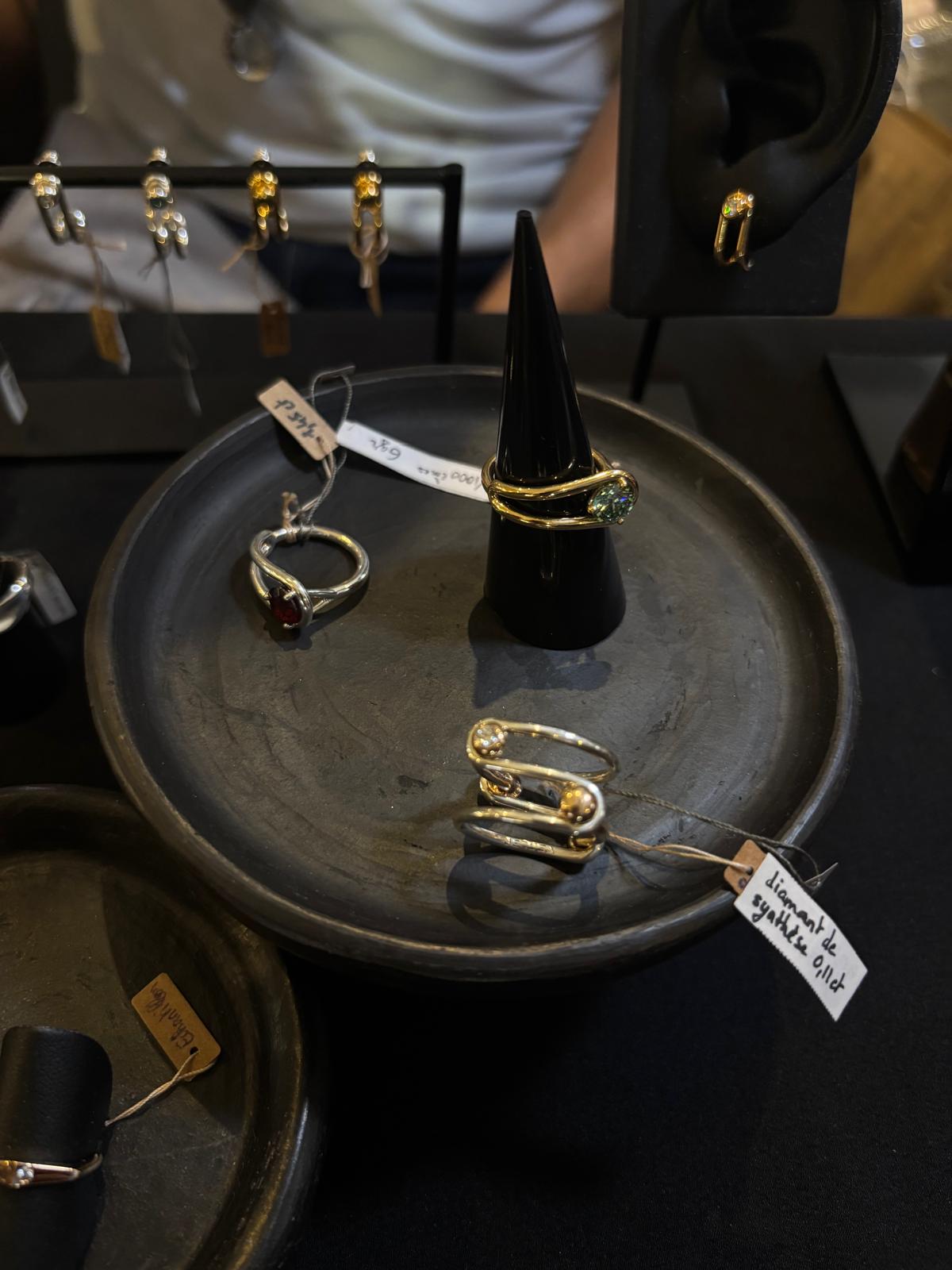
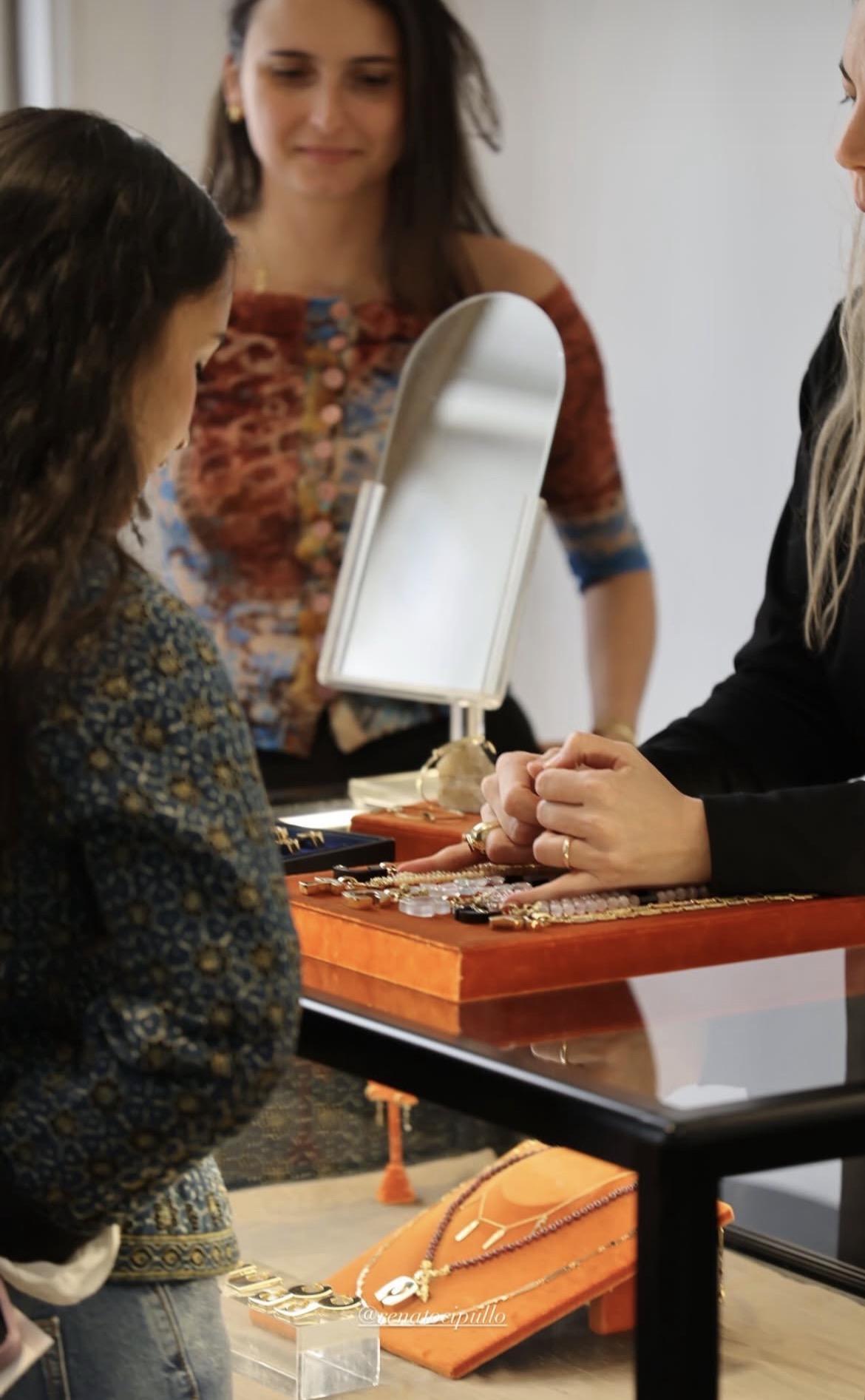
There are places where you go to look at jewellery, and then there are places where you begin to understand why we have always felt the need to make it.
In Surya Mathew’s Paris salon, time seems to move differently. Peacock silk spills across the armchairs, jasmine garlands rest against a brass oil lamp, and books on jewellery and art line the shelves, their spines illuminated by a gentle, almost devotional light. Nothing feels hurried. Nothing feels incidental. Even the smallest object seems to have earned its place.
And then there is Surya himself, perched on an office chair, speaking with his hands, his thoughts moving as freely as his gestures.
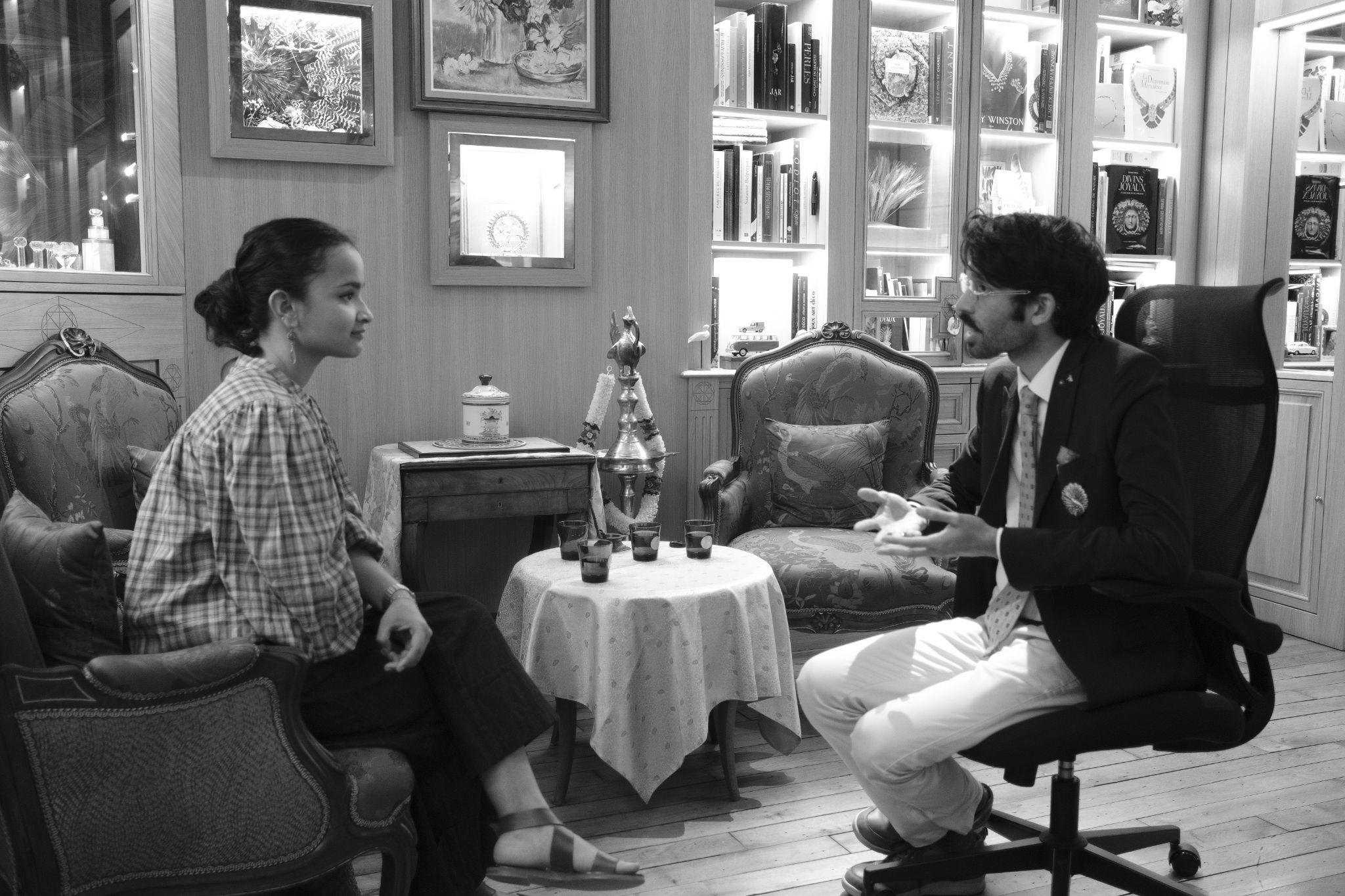
In conversation in his Paris salon, surrounded by the books and objects that shape his work.
Ask him about jewellery, and he is unlikely to begin with a stone, a setting or a technique. He speaks instead of listening. Of allowing a piece to reveal what it wants to become. It is an unusual way of describing a craft so often associated with precision and control, but the longer one listens, the more it makes sense. For Surya, a jewel is never simply made. It is discovered, remembered, and given a form.
This year, his work found a place at Homo Faber in Venice, the international celebration of master craftsmanship. Yet to understand what brought him there, one must travel much further back, to Kerala, to a ten-year-old boy standing in the workshop of a man who would change the course of his life.
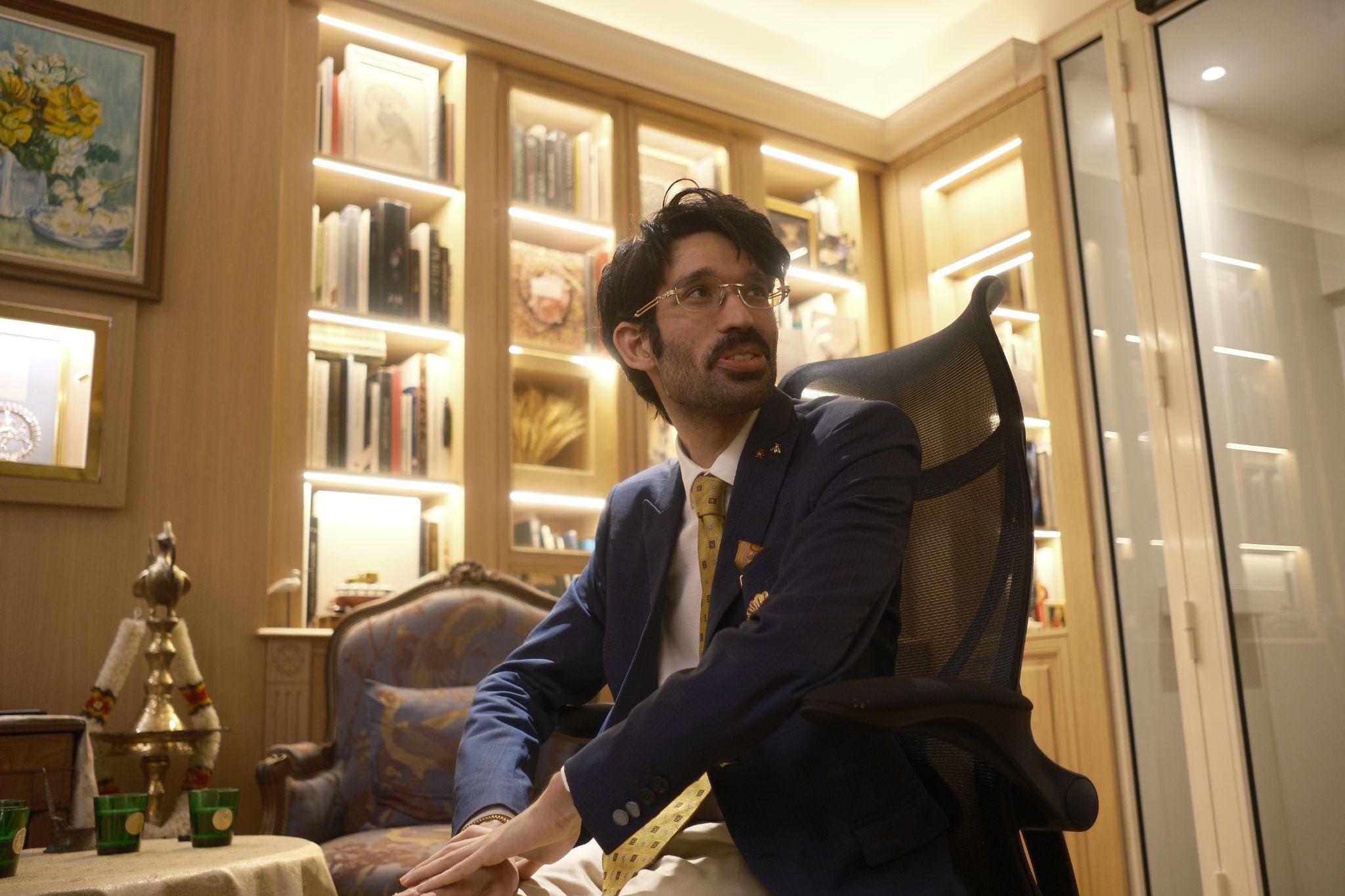
Surya Mathew, founder of Maison Surya Mathew. Two masters, and a world of inherited knowledge
Surya was ten when he met Nadesan, his first teacher. In his workshop, working with metal was inseparable from the invisible world that surrounded it. Sacred geometry, astrology and traditional beliefs about the protective powers of gemstones informed the craft. A jewel could be beautiful, certainly, but it could also serve a purpose beyond the visible: to protect, to guide, to connect its wearer to something greater than themselves. At thirteen, Surya began learning from Dhanaplan, a sixth-generation artisan whose family had created jewels for the Maharajas. Here was a different kind of inheritance, one measured not in objects or wealth, but in the knowledge held by human hands.
There was, however, a problem. Dhanaplan had no heir to whom he could pass on the techniques his family had guarded for six generations.
What followed was an extraordinary act of trust. Surya was not born a Brahmin, and the traditions surrounding the transmission of this knowledge were deeply rooted in caste. Dhanaplan chose to perform the traditional initiation rites and accept him as a spiritual son, creating a path through which the family’s knowledge could survive.
I find something particularly moving in this part of Surya’s story. An inheritance is so often understood as something we receive by birth, something that belongs to us because of where we come from. Here, it was entrusted to someone because of what he might carry forward. The bond between master and apprentice became something more enduring than a transfer of skill: a promise that knowledge would not end with the person who held it. Perhaps this is where Surya’s understanding of jewellery begins. Not with ownership, but with guardianship.
From Place Vendôme to sacred art
At sixteen, Surya arrived in Paris with a suitcase and little else. He trained at the Haute École de Joaillerie before entering the world of high jewellery, creating crowns and exceptional commissions for the great houses of Place Vendôme. It was, by any conventional measure, the kind of trajectory one might dream of. He had acquired the technical mastery to work at the highest level of his profession, in a city whose relationship with jewellery is inseparable from ideas of luxury, excellence and desire. And yet, something was missing.
In the world he inhabited, a jewel could be evaluated by its carat weight, the rarity of its stones or the perfection of its finish. These things mattered, and Surya understood them intimately. But they did not answer the questions that had followed him since childhood. What did a jewel mean to the person who wore it? What could it protect, preserve or commemorate? And what happened to the relationship between a jewel and its wearer when its value became primarily a matter of material worth?
Eventually, he chose to leave that world behind and establish Maison Surya Mathew. He describes his practice as Haute Joaillerie d’Art Sacré: a meeting between the technical rigour of European high jewellery and the spiritual traditions of India. It is not a rejection of luxury, but a different way of approaching it. The craftsmanship remains extraordinary; what changes is the intention behind it.
In Surya’s hands, precious materials become a language through which beliefs, memories and relationships can be expressed. The jewel is no longer simply the final object. It is the physical trace of something that might otherwise remain invisible. Maison Surya Mathew, where the precision of haute joaillerie meets the spiritual traditions of India.
When a jewel becomes a vessel for memory
Perhaps the most revealing thing about Surya’s practice is what happens before he begins to design.
People arrive at his salon carrying things that have already lived a life. Old gold, inherited gemstones, jewels that belonged to a mother, a grandmother, a loved one who is no longer there. These objects can be difficult to part with, even when their settings no longer feel relevant or their forms no longer reflect the person who wears them. Their value cannot be measured by weight alone. Sometimes, a stone carries the memory of a particular hand. Sometimes, a piece of gold is precious because it has spent decades close to someone’s skin. To melt it down or dismantle it is not necessarily to lose its material substance, but it can feel like disturbing a story whose ending has not yet been written. Surya begins by listening. He asks about the person, their life, their losses and their hopes for the future. The conversation becomes the starting point for the jewel itself. There is something quietly radical about this approach. In an industry that often begins with a sketch, a collection or a stone, he begins with a human being.
One commission captures this beautifully. A client came to him with more than three hundred inherited diamonds and sapphires. She wanted to bring her family’s history together in a single jewel, one that she could wear in her lifetime and eventually pass on to her two sons.
Surya created a sculptural ring built around leaf motifs, concealing a system of catches within its structure. On her hand, it appears as one complete, striking piece. But the ring holds another possibility within itself: it can be unlocked and divided into two identical rings, allowing each son to inherit an equal share of the gold and gemstones.
Nothing needs to be broken to make room for the next generation. Nothing needs to be diminished for the inheritance to be shared.
I keep returning to this detail. The ring is designed not only for the woman who wears it today, but also for the two people who will one day receive it. Its beauty lies partly in this ability to anticipate a future it will never experience in its present form. The jewel becomes an act of care extended across time. It allows a family’s history to change shape without losing its substance, making space for the future without asking the past to disappear.The beauty of what survives
At one point during our conversation, Surya brings out a tray of small bronze moulds. Their edges have been softened by years of use; their surfaces carry impressions of flowers, leaves and tiny faces. Some are around two hundred years old, yet they remain part of the working life of his atelier.
I find myself drawn to these objects as much as to the finished jewels. There is an intimacy to a tool that has been handled across generations. Its surface records a history that no written account could quite reproduce: the pressure of a hand, the repetition of a gesture, the gradual accumulation of time.
The moulds have survived because someone continued to use them. For Surya, preserving this knowledge is not an exercise in nostalgia. He continues to work with Dhanaplan and a network of traditional craftsmen in India, keeping techniques alive that risk being pushed aside by the speed and standardisation of mass production. In his Paris atelier, each piece passes through the same patient process of making, with the hand remaining central to the result.
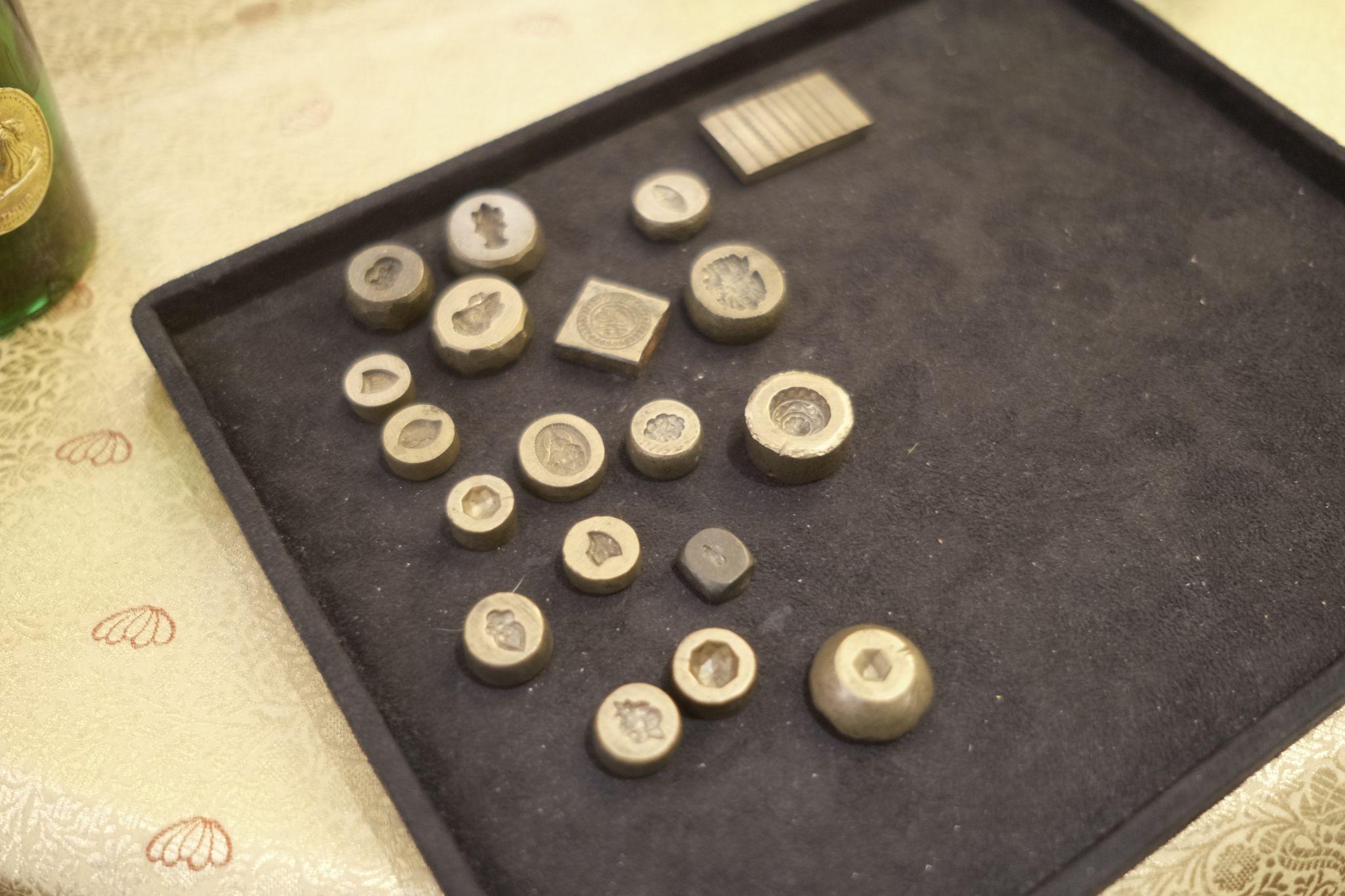
Bronze moulds, some around two centuries old, continue to shape the work of the atelier.
It makes me think about what we mean when we speak of craftsmanship as heritage. Heritage can easily become something we admire from a distance, preserved behind glass or invoked in the language of a brand. But a technique is only truly alive when someone continues to practise it, when knowledge moves from one pair of hands to another, and when there is still a reason to make something in the old way.
A bronze mould does not survive simply because it is old. It survives because it is useful, because someone recognises what it can do, and because its knowledge still has somewhere to go.
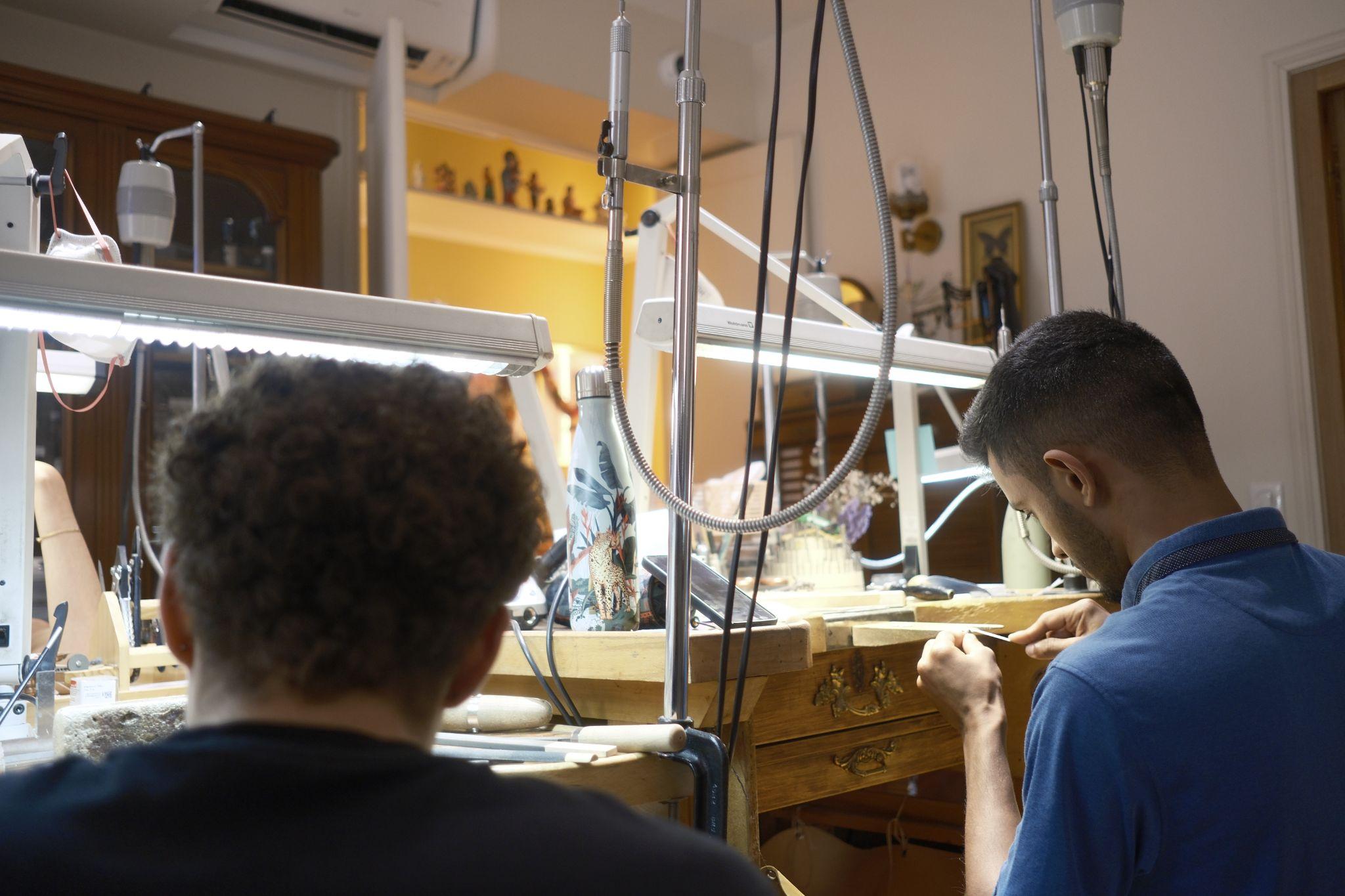
The same might be said of a jewel.
At the bench in the Paris atelier, each piece is finished by hand.
We are only temporary guardians
By the time I leave Surya’s salon, I find myself thinking less about the finished pieces than about everything they contain: the knowledge of a master who chose to pass it on, the memory of a woman who wants her children to inherit more than gemstones, the hands that have repeated the same gestures for generations.
This, perhaps, is what Homo Faber recognised in Surya’s work. Not only the mastery of a rare craft, but the understanding that craftsmanship can carry something far greater than itself.
We tend to speak of jewellery in the language of permanence. Gold does not tarnish easily; diamonds endure; precious stones can outlive the people who first wore them. Yet the stories attached to these objects are anything but static. They move from one person to another, acquiring new meanings along the way. A jewel may begin as a gift, become an heirloom, and eventually be transformed into something that its original maker could never have imagined.
Surya often returns to the idea that we are only temporary guardians of what we hold. It is a deceptively simple thought, and one that changes the way I look at jewellery. Perhaps the most precious thing about an inherited jewel is not that it has survived unchanged, but that someone has cared enough to carry it forward. Perhaps its true value lies in the lives it has touched, the memories it has preserved and the possibilities it still holds.
In a world that so often asks us to acquire more, Surya invites us to consider what it means to take care of what we already have. And perhaps that is the quietest, most enduring form of luxury: not simply to possess something beautiful, but to become part of its story, before passing it on.