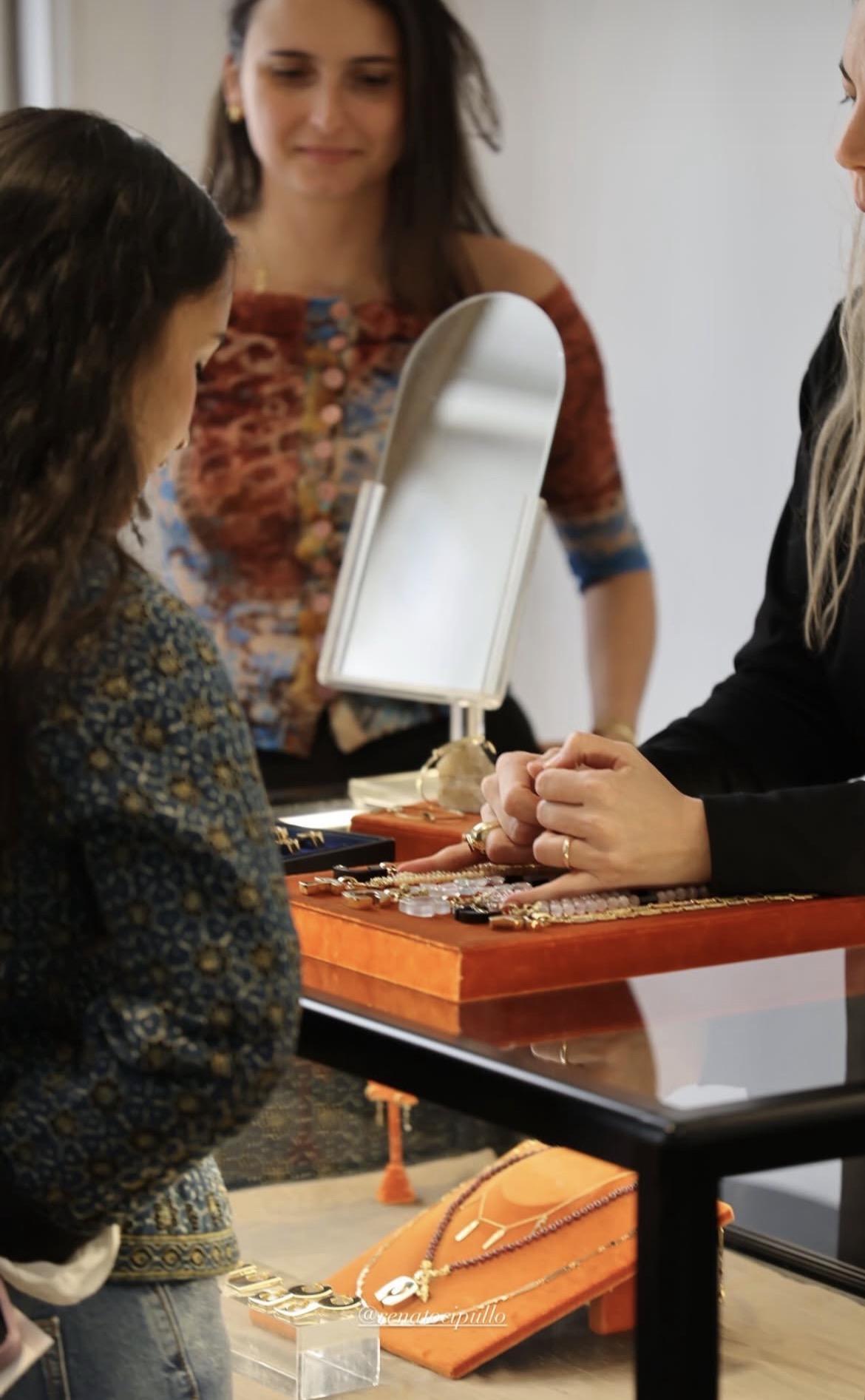
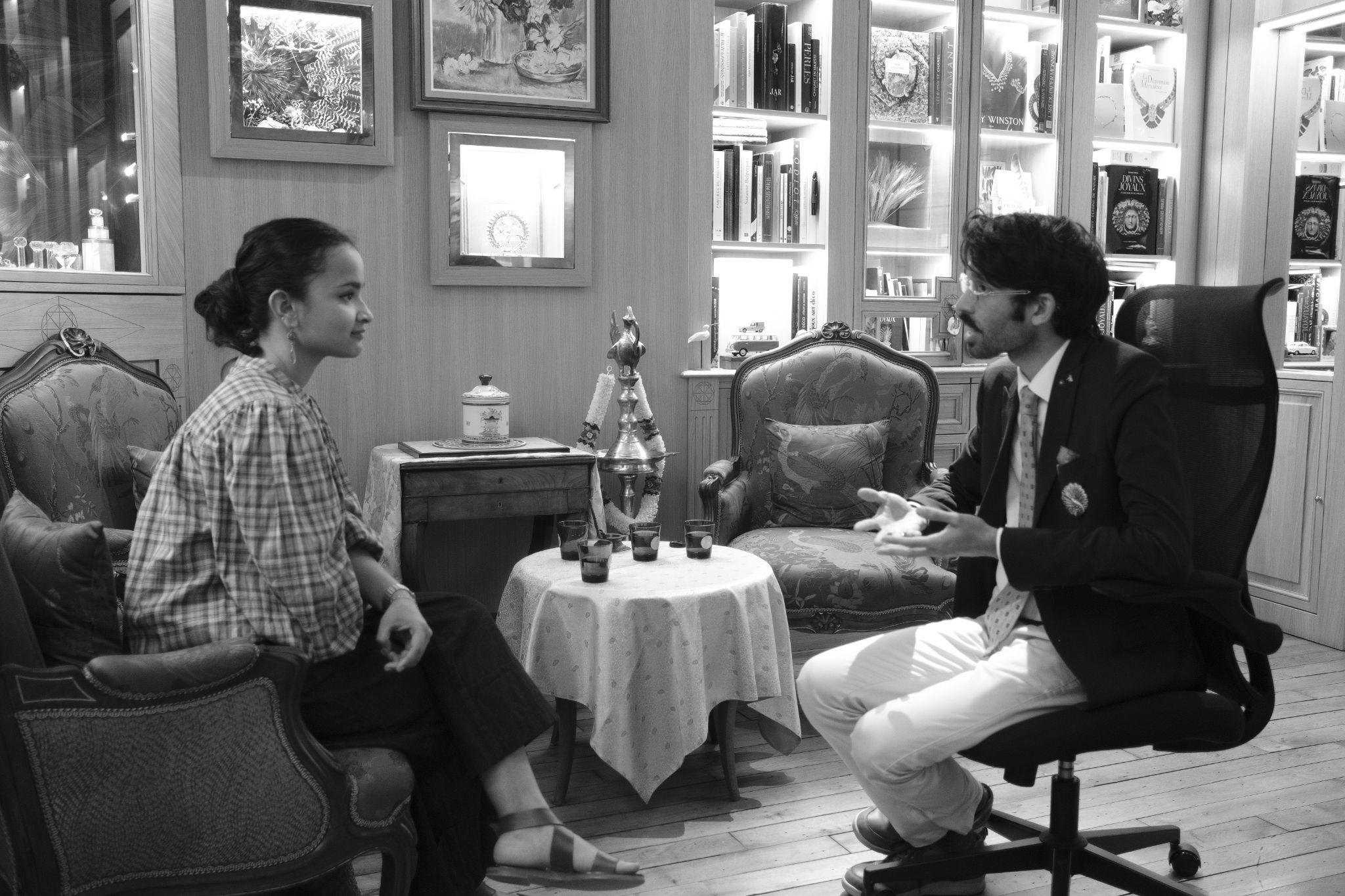
We rarely wear a ring alone. On most hands there is a small, unspoken composition at work: an old family band beside something new, a slim stack chosen in the morning and rearranged by evening, a single favourite that moves from finger to finger depending on the mood. We already mix and match, almost without noticing, gathering memory and instinct into one gesture. It was at the 8th Salon de la Gemm'Academy, among the stones and the quiet conversations of people who spend their lives looking closely, that I met Vesler, a young Parisian house that has taken this instinct and turned it into a design language.
At the heart of Vesler is the Switch, the ring the house considers its signature. Its designer, Pierre-Aymeric, set out to create a unisex ring that was simple, soft and quietly sophisticated, both in how it works and in how it is worn. The idea is deceptively modest. A frame of silver wire is designed to receive interchangeable bridges: straight, twisted, or set with a stone or a pearl. From a single frame and a handful of bridges, one can compose a whole family of rings: polished silver one day, warm bronze the next, a twisted form for texture, a set diamond for evening. The ring does not ask you to choose once and for all. It allows you to change your mind
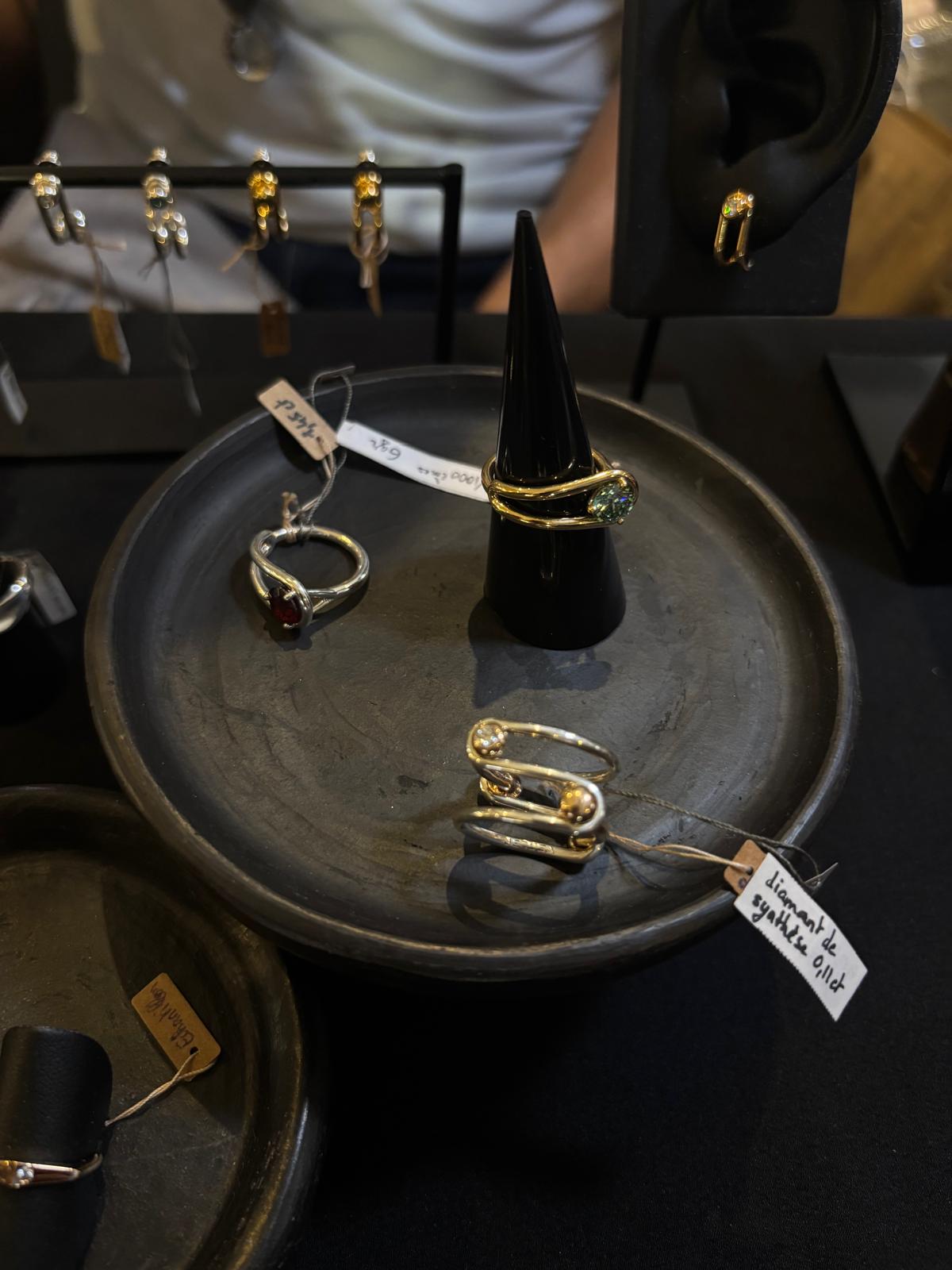
There is a subtlety in this that I found myself returning to long after the salon. The bridge can be worn facing upward, for a bolder statement, or turned vertically, for something more discreet, letting the stone or pearl on its small sphere catch the light from a different angle. The same jewel, then, holds two characters within it, and the wearer decides which one speaks. In a world where luxury so often dictates how a piece should be worn, there is something quietly radical in a ring that hands the decision back.
What makes the Switch more than a clever mechanism is the way it lives alongside other jewels. Its clean, geometric lines are drawn to sit comfortably beside richly ornamented antique rings, contemporary pieces, even a classic engagement ring. This is where the savoir-faire of mixing and matching truly begins. A modular ring is not designed in isolation; it is designed for conversation, with the jewels you already own, with the ones you have inherited, with the ones you have not yet found. It becomes a kind of punctuation on the hand, a line that connects an heirloom to the present without competing with it.
The same sensitivity runs through Vesler's Dune collection, where the house moves from engineering to sculpture. Each ring evokes the ripple of a desert, the Namib, the Sahara, the Thar, the Gobi, and each begins as a block of wax carved by hand before being cast in solid bronze or silver in Paris. Entirely conceived and made in the city, the collection has been awarded the Fabriqué à Paris 2025 label. The smallest of them, the Namib, is meant to be worn every day and layered with other rings, its soft undulations sitting naturally against a straight Switch bridge or a slim antique band. Seen together, the two collections speak the same idea in different dialects: one through modular precision, the other through the slow, organic hand of the sculptor.
Vesler's choice of materials carries its own quiet philosophy. Solid silver and solid bronze, rather than gold, keep the house's pieces within reach while remaining noble and durable, and the silver is passivated to protect it from tarnish. Pieces are designed in Paris and made largely in France, with certain components polished in a partner workshop in Portugal. There is no grand mythology here, only a clear and contemporary conviction: that a jewel should be well made, honestly made, and made to evolve with the person who wears it. In the end, Vesler reminds us that savoir-faire is not only about how a jewel is made, but about how it continues to live once it leaves the workshop. A ring that can be rebuilt, turned, paired and reimagined is a ring that grows with its wearer, gathering new meanings rather than holding on to a single one forever.
Holding a Switch frame in one hand and a loose bridge in the other, I felt a small, unexpected freedom. It made me look differently at my own rings, the ones I wear out of habit, and the ones I keep in a box because they never seemed to belong together. Perhaps they were only waiting for the right link between them. Perhaps the most personal jewel is not the one we buy complete, but the one we keep composing, quietly, over a lifetime.