
I’ve started to notice that the most interesting changes in high jewellery aren’t happening inside ateliers or flagship boutiques. They’re happening in auction houses. What used to be a secondary market, a place where jewels went after their first life, is now increasingly where meaning, collectibility, and even creativity are being shaped from the start.
To me, this shift becomes clear when you look at how auction houses collaborate with designers, digital creators, institutions, and cultural figures. In this piece, I’ll be diving into four key dynamics behind this transformation: blockchain-linked digital collaborations, contemporary designers launching directly through auctions, the power of celebrity visibility in creating instant collectibility, and the growing influence of museum-style institutional partnerships. Together, they reveal how the auction world is quietly redefining what high jewellery means today.
1. When jewellery meets the blockchain: experimentation with digital creators
One of the clearest examples of this new model is the Ethereum Expedition ring by Metagolden, sold during Sotheby’s 2022 Art as Jewelry as Art sale (below). The project paired a physical emerald ring with an NFT twin, creating a hybrid object that existed both materially and digitally. Through this collaboration, Sotheby's wasn’t simply selling a jewel; it was validating a new way of owning one.
I think what makes this important is not the technology itself, but the partnership structure behind it. A digital-native creator brings conceptual innovation, while the auction house supplies institutional legitimacy and access to collectors. Without that institutional framing, the NFT element might feel speculative or niche. With it, the piece becomes positioned as serious high jewellery, just expanded into a new medium.

To me, this signals that auction houses are testing how far the definition of jewellery can stretch while still feeling collectible. The physical ring reassures traditional buyers; the NFT attracts a younger, tech-oriented audience. The innovation isn’t disruptive in the sense of replacing craftsmanship. It’s additive, layering new forms of authorship and ownership on top of traditional luxury codes.
1. The auction as a launchpad, not a resale venue
Another shift I find fascinating is how contemporary designers are now producing pieces directly for auction circulation. Historically, auctions relied on estate jewels or vintage maison creations. Today, designers like Feng J are creating works that enter the market already framed as collectible. (below)
Her Chrysanthemum Brooch and Dancing Butterfly Ring are good examples. These weren’t rediscovered historical pieces; they were contemporary works presented within the auction ecosystem as if they already belonged in a collector’s canon. That framing matters enormously. When a new jewel appears in an auction catalogue rather than a retail display, it is immediately read differently: less as a product, more as artwork.
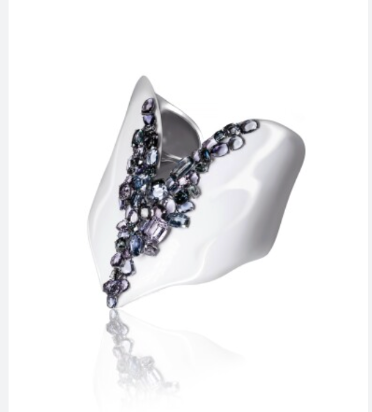
I think this changes the role of the auction house. Instead of documenting taste, it begins to manufacture it. By selecting which contemporary designers receive this platform, the auction house effectively signals who deserves to be taken seriously by collectors. The auction becomes a site of artistic validation, not just financial exchange.
For designers, the advantage is obvious: immediate exposure to ultra-high-net-worth collectors and the aura of institutional endorsement. For the auction house, it guarantees novelty and exclusivity. And for collectors, it creates the feeling of acquiring something already positioned within history, even though it has just been made.
2. Celebrity visibility and the creation of instant collectibility
The ecosystem becomes even more interesting when celebrity association enters the picture. Jewellery linked to high-profile figures often gains cultural resonance that exceeds its material value. Designers such as Kindred Lubeck, whose work has been associated with commissions connected to Taylor Swift’s engagement ring, show how this dynamic works in practice.
When such pieces appear in auction contexts or curated sales, the narrative shifts from craftsmanship alone to cultural visibility. I think what auction houses understand very well is that collectibility today depends as much on story as on stones. Celebrity-linked jewellery carries built-in narrative capital: it signals contemporary relevance while still fitting into the tradition of provenance-driven luxury.

Designers, gemstone dealers (Gemstone dealer Anup Jogani also saw his profile rise once details of Taylor Swift’s ring surfaced, evidence that in the rarefied world of high jewellery, even a whisper can function as a global announcement.) celebrity narratives, and collector audiences are all woven into a single story that elevates the object beyond ornament. The collaboration becomes less about producing a jewel and more about producing its cultural positioning.
3. Borrowing museum authority without becoming museums
Another form of partnership shaping high jewellery auctions comes from collaborations with cultural institutions and exhibition spaces. I think this is particularly visible in Paris, where jewellery collections are increasingly displayed in environments that blur the line between museum and market.
The presentation of the Al Thani Collection at the Hôtel de la Marine, organised with the Centre des Monuments Nationaux, is a good example of how jewellery can circulate within institutional frameworks that emphasise heritage, scholarship, and artistic legitimacy. Even when not directly tied to a specific sale, such exhibitions shape the broader environment in which auction houses operate.
I think the effect is subtle but powerful. When jewellery is staged in museum-like contexts, it becomes easier to read auction pieces as cultural artefacts rather than luxury goods. Auction previews increasingly adopt similar scenography: dramatic lighting, historical essays, archival references, and carefully curated narratives. These strategies don’t necessarily change the jewel itself, but they transform how we perceive its value.
The partnership between auction logic and institutional display creates a feedback loop. Museums reinforce the artistic status of jewellery; auctions translate that status into market confidence. Together, they stabilise the idea that high jewellery belongs simultaneously to culture and commerce.
Finally, taken together, these developments suggest that the future of high jewellery auctions will be defined less by the jewels themselves than by the partnerships that frame them. Whether through digital collaborations that expand ownership into the blockchain, contemporary designers debuting directly through auction platforms, celebrity-linked narratives that accelerate recognition, or institutional exhibitions that confer cultural legitimacy, auction houses are no longer simply selling objects — they are constructing the contexts that make those objects desirable.
I think what’s most striking is how these strategies quietly dissolve the old boundary between primary creation, cultural validation, and resale. The auction becomes at once a launch stage, a storytelling platform, and a legitimising authority. In this ecosystem, value emerges from alignment: between designer and institution, narrative and market, visibility and scarcity.