Picture this: a merchant in 3rd-century Mohenjo-daro presses a small carved seal into a lump of wet clay, and in that one fi rm gesture, she says, this is mine, this came from me, my word is behind this. That seal? It was wrapped around her little fi nger. And that instinct, to mark, to claim, to declare never left us. We just swapped the clay for gold.
I've been somewhat obsessed with signet rings lately. Not in the way one gets obsessed with a trend, but in the way you get obsessed with something that makes you feel like you've fi nally remembered something you always knew. There's a directness to them, a lack of apology, that feels almost radical in a world drowning in dainty layering necklaces and whisper-thin bands.
Carol Woolton, the jewellery editor and writer whose thinking I fi nd myself returning to again and again, talks about jewellery as an autobiography. She means it literally, that what you choose to wear is a kind of self-authorship, a way of writing yourself into the room before you've said a word. And if that's true, then a signet ring is perhaps the boldest sentence in that autobiography. It's the fi rst-person singular. It's I.
Interestingly, the signet ring was not just a western phenomenon. The Indus Valley civilisation, Harappa, Mohenjo-daro, produced stamp seals as far back as 2600 BCE. But unlike their Egyptian or Mesopotamian counterparts, these seals weren't purely administrative. They were cosmological. They depicted animals that held spiritual weight: the humped bull, the one-horned unicorn, the seated yogic fi gure that some scholars believe is proto-Shiva himself.
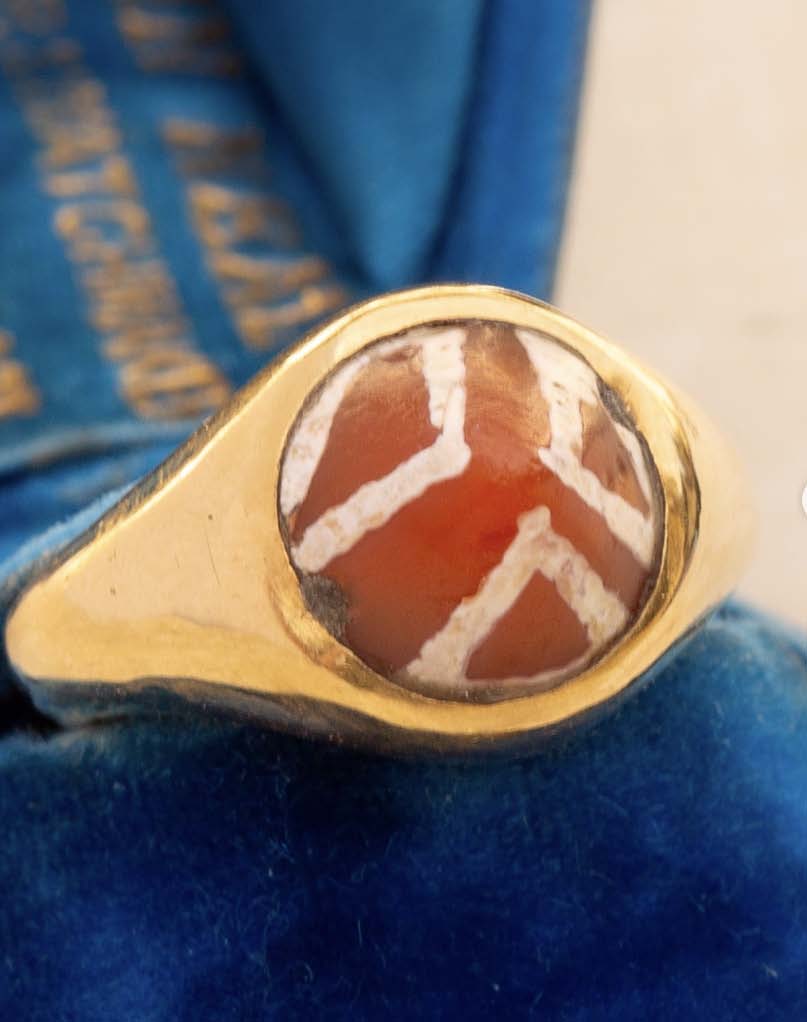
An unusual ancient ‘Indus Valley’ etched carnelian bead signet ring. The conical shaped bead dates from the middle of the third millennium BC. Deep orange in colour with white patterned etchings, these alkaline-bleached beads originate from the Indus Valley civilisation.It has been later mounted in a high-karat gold ring mount.
Pendants with Indus script signs on them. Prof. Toshiki Osada speculates that "they may have served as an individual and distinct passport for those traveling between diff erent regions."
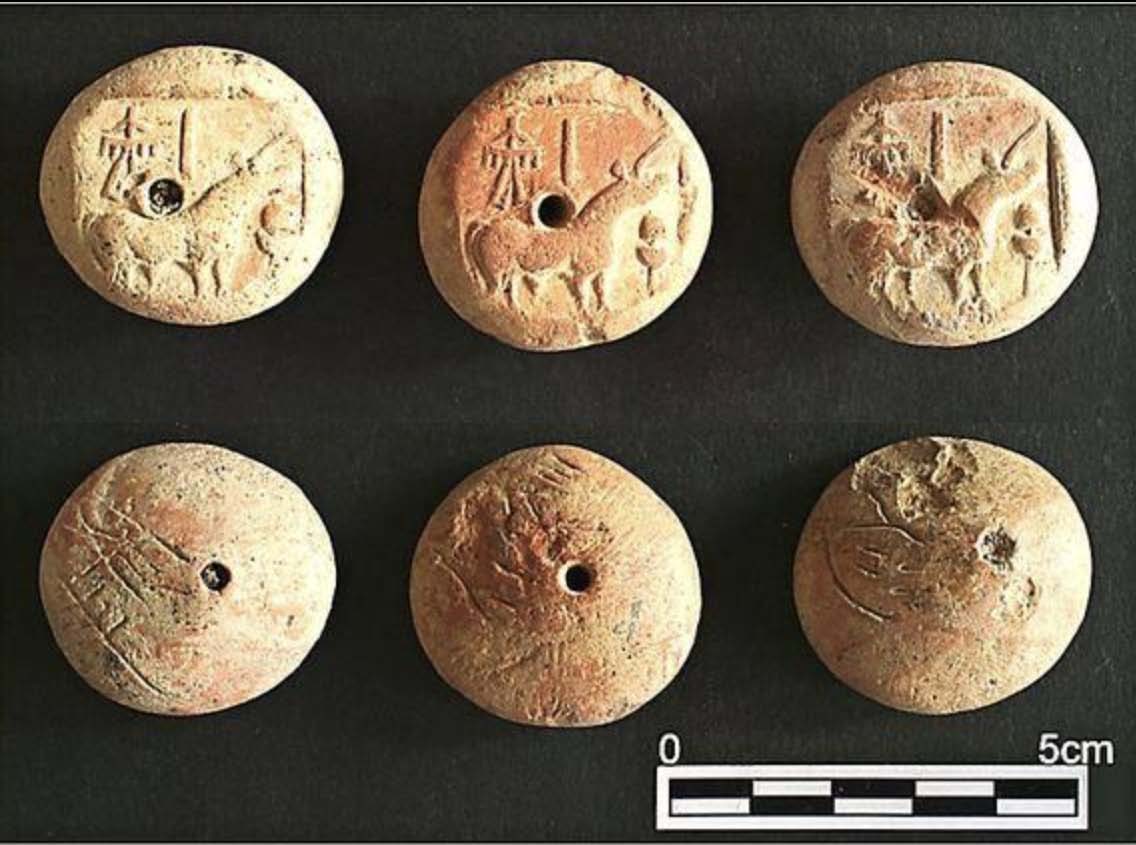
Think about what that means. Your seal, your personal mark, the thing that said this is me, was also a tiny cosmology. It carried your name and your universe simultaneously. I fi nd that extraordinarily beautiful. And honestly? It's a design brief that contemporary jewellers are now catching up to.
Later, in the Mughal courts of the 16th and 17th centuries, the signet ring evolved into something almost impossibly lavish. The muhr, the Persian-Urdu word for seal, was a political instrument as much as a personal one. Emperors like Akbar and Shah Jahan had their seals engraved with calligraphic inscriptions: verses from the Quran, titles, names of God. These weren't vanity pieces. They were walking constitutions. When that ring pressed its mark into wax, it was the whole empire speaking.
So what happened? The 20th century happened — and with it, a democratisation of fi ne jewellery that was, on balance, a wonderful thing. But it also meant that the signet ring got fl attened into a symbol of a very particular English aristocracy: the old school, the hereditary crest, the chunky gold oval. For a while, it felt like the signet ring belonged to people who had arrived somewhere, not people who were on their way.
And then, because fashion always finds the thing that's been sleeping and wakes it up sideways, the signet ring came roaring back. Designers like Fernando Jorge began carving out space (sometimes literally, his hollow-form rings feel like architecture) for signets that reference pre-Columbian forms and ancestral geometry. Bleue Burnham makes signets that feel like they were unearthed from a future civilization, strange, organic, almost biological in their surfaces. Hemmerle in Munich pairs iron with gold in a way that feels deliberately anti-precious, asking you to reconsider what "valuable" even means. And closer to the Indian tradition, designers like Amrapali have reintroduced the kundan and jadau approach, inlay work so precise it looks like the stone grew there, into rings that carry that same ancestral weight without being costume.
What all these designers share, and what Woolton might recognise as the connective tissue, is that they're treating the signet ring as a vessel. Not for a family crest, necessarily, but for a story. Your story. And that shift, from inherited identity to chosen identity, feels like the essential move of our current moment.
I want to talk about the actual physics of a signet ring for a moment, because I think we underestimate how much the object itself does the work. A signet ring is heavy. Not oppressively so, but enough that you feel it. It settles on your fi nger with a kind of gravity, and I mean that almost philosophically. There's a reason the phrase "carrying weight" exists. When you wear a signet ring, you are, quite literally, carrying something.
In Indian tradition, we understand this viscerally. The wearing of rings is never incidental, each fi nger carries meaning, each metal carries a planet, each stone carries a quality you are either invoking or harmonising with. Even in secular contexts, the gesture of wearing a ring on a specifi c fi nger feels intentional in a way that, say, a bracelet simply doesn't. The ring stakes a claim on the body. It says: this hand has decided something.
And the fl at face of the signet, that bezel, that table, is the most interesting real estate in jewellery. It can hold almost anything. A monogram. A phrase in Sanskrit or Arabic or Greek. An animal. A geometric abstraction. A family emblem or a self-invented one. Designers at Foundrae have built an entire language of signet-like medallions around this idea, that the face of the ring is a canvas for whatever system of meaning you actually live by. Theirs feature icons of wholeness, karma, strength, wanderlust. You pick what resonates. You wear what you believe.
We live in an age of extreme personal curation, curated feeds, curated aesthetics, curated selves, and somewhere in all that curation, the actual self can get a bit lost. A signet ring, at its best, cuts through that. It asks you: what is your mark? Not your aesthetic, not your vibe, not your moment. Your mark. The thing that would be unmistakably, indelibly, permanently you.
The merchants of Mohenjo-daro knew. The Mughal emperors knew. Vita Sackville-West knew. Carol Woolton knows. And I suspect, if you've read this far, some part of you knows too.